Işığın renklerini ve rengi inceledi. Prizmadan geçen ışığın çıkardığı renklerin sıcaklıklarını ölçtü.
Spektrumun bir ucundaki mor ışık en düşük, diğer ucundaki kırmızı ışık ise daha büyük sıcaklıktaydı.
1738-1822
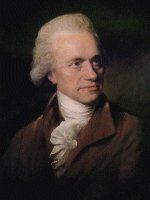
William [Wilhelm Friedrich] Herschel was born on 15 November 1738 in Hanover, in
a family of musicians. In 1757, at age 19, he fled to England. With his name
anglicized to William, Herschel began earning a living as an organist and later
composer and conductor. In 1772 convinced his sister Caroline to join him as an
accompanying singer. In their spare time the brother-sister team became engaged
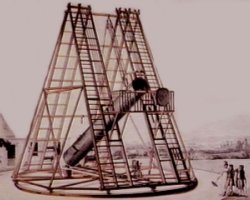
in astronomy, in particular in the building of ever greater size and magnifying
power. William died at his home in Slough, near Windsor, on August 25 1822, and
Caroline on September 1 1848.
Herschel's first major discoveries were to show that Mars and Jupiter exhibit
axial rotation. Herschel struck fame in 1781, when on March 13 he discovered the
planet Uranus while engaged in work aimed at determining stellar parallax. This
being the first new planet discovered since Antiquity, Herschel, until then a
mere amateur astronomer relatively unknown even in England, became a celebrity.
Adopting an historically proven strategy, Herschel named the new planet Georgium
Sidum, in honor of the then ruling English monarch George III. The trick worked
once again, as King George III gave William and Caroline the titles of "The
King's Astronomer" and "Assistant to the King's Astronomer", an honor which came
with a life's pension for both. In 1782 they moved to Bath, and shortly
thereafter to Slough, near Windsor, and from this point on William and Caroline
could devote themselves entirely to astronomy. The Heschels went on to discover
two moons of Uranus in 1787, and two new moons of Saturn.
Herschel's work on double stars, which he pursued intermittently between 1782
and 1821, provided the first demonstration that gravity acted also outside the
solar system. He also made one of the first attempts at measuring the Sun's
motion through the galaxy via the proper motion of nearby stars. This became yet
another step in the removal from the Earth as the center of the Universe. His
increasingly large and powerful telescopes also allowed him to resolve many of
the hitherto mysterious "nebulae" into clusters of faint stars. Anticipating in
some ways Laplace's model for the formation of the solar system, Herschel
developed an evolutionary theory of the universe, where, starting from a uniform
"initial state", stars form and clump into nebulae.
While Caroline became increasingly occuppied with the search for comets (at
which she was quite successful), William became for a time interested in the
Sun. Inspired by Wilson's 1774 work, he put forth the theory of sunspots as
openings in the Sun's luminous atmosphere, an opinion that was to endure well
into the nineteenth century. In 1800 he became interested in the solar spectrum,
and uncovered the first evidence for solar energy output outside of the visible
spectrum, in what is now known as the infrared. In 1801 he published two papers
that, in part because of Herschel's reputation, effectively launched the field
of solar influences on Earth's weather. It is in the first of these papers that
Herschel discusses an anticorrelation between the price of wheat and the number
of sunspots visible on the Sun.