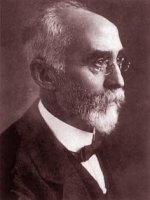
Doğum Tarihi - 18 Temmuz 1853, Arnhem, Netherlands
Ölüm Tarihi - 4 Şubat 1928, Haarlem, Netherlands
Hendrik Lorentz attended Mr Timmer's Primary School in Arnhem until he was 13
years of age when he entered the new High School there. He entered the
University of Leiden in 1870 but, in 1872, he returned to Arnhem to take up
teaching evening classes. He worked for his doctorate while holding the teaching
post.
Lorentz refined Maxwell's electromagnetic theory in his doctoral thesis The
theory of the reflection and refraction of light presented in 1875. He was
appointed professor of mathematical physics at Leiden University in 1878. He
remained in this post until he retired in 1912 when Ehrenfest was appointed to
his chair. After retiring from this chair, Lorentz was appointed director of
research at the Teyler Institute, Haarlem. However, he retained an honorary
position at Leiden, where he continued to lecture.
Before the existence of electrons was proved, Lorentz proposed that light waves
were due to oscillations of an electric charge in the atom. Lorentz developed
his mathematical theory of the electron for which he received the Nobel Prize in
1902. The Nobel prize was awarded jointly to Lorentz and Pieter Zeeman, a
student of Lorentz. Zeeman had verified experimentally Lorentz's theoretical
work on atomic structure, demonstrating the effect of a strong magnetic field on
the oscillations by measuring the change in the wavelength of the light produced.
Lorentz is also famed for his work on the FitzGerald-Lorentz contraction, which
is a contraction in the length of an object at relativistic speeds. Lorentz
transformations, which he introduced in 1904, form the basis of Einstein's
special theory of relativity. They describe the increase of mass, the shortening
of length, and the time dilation of a body moving at speeds close to the
velocity of light.
Lorentz was chairman of the first Solvay Conference held in Brussels in the
autumn of 1911. This conference looked at the problems of having two approaches,
namely that of classical physics and of quantum theory. However Lorentz never
fully accepted quantum theory and always hoped that it would be possible to
incorporate it back into the classical approach. He said in his presidential
address at the opening ceremony of the conference:-
In this stage of affairs there appeared to us like a wonderful ray of light the
beautiful hypothesis of energy elements which was first expounded by Planck and
then extended by Einstein and Nernst, and others to many phenomena. It has
opened for us unexpected vistas, even those, who consider it with a certain
suspicion, must admit its importance and fruitfulness.
Some of Lorentz's numerous publications are highlighted in [3]:-
In an early memoir, which became famous, Lorentz applied for the first time
considerations relating to discrete molecules to electric propagation in
material bodies, and incidentally arrived at a rational reflection-equivalent
for each substance independent of its density. In 1884 he began to study the
effect which magnetization exerts on the polarization of reflected light. His "Théorie
Electromagnétique de Maxwell et son application auz Corps Mouvants" and his "Versuch
einer Theorie der Elektrischen und Optischen Erscheinungen in bewegten Körpern"
were published in 1892 and 1895 respectively. They embodied the first systematic
appearance of the electrodynamic principle of relativity, and in 1920 he brought
out "The Einstein Theory of Relativity: A Concise Statement". In 1909 he
published his "Theory of Electrons", based on a series of lectures at Columbia
University, and in 1916 he published in French at Leipzig an account of
statistical thermodynamic theories, based on lectures delivered at the Collège
de France in 1912. An edition of his University lectures, entitled "Lessons on
Theoretical Physics", began to appear, under his supervision, in 1919. He was
also the author of a textbook of the differential and integral calculus; "Visible
and Invisible Movements", 1901; and "Clerk Maxwell's Electromagnetic Theory",
1924.
In [7] O W Richardson describes Lorentz as:-
... a man of remarkable intellectual powers ... . Although steeped in his own
investigation of the moment, he always seemed to have in his immediate grasp its
ramifications into every corner of the universe. ... The singular clearness of
his writings provides a striking reflection of his wonderful powers in this
respect. .... He possessed and successfully employed the mental vivacity which
is necessary to follow the interplay of discussion, the insight which is
required to extract those statements which illuminate the real difficulties, and
the wisdom to lead the discussion among fruitful channels, and he did this so
skilfully that the process was hardly perceptible.
Lorentz received a great many honours for his outstanding work. He was elected a
Fellow of the Royal Society in 1905. The Society awarded him their Rumford Medal
in 1908 and their Copley Medal in 1918.
The respect in which Lorentz was held in The Netherlands is seen in Richardson's
description of his funeral [7]:-
The funeral took place at Haarlem at noon on Friday, 10 February. At the stroke
of twelve the State telegraph and telephone services of Holland were suspended
for three minutes as a revered tribute to the greatest man Holland has produced
in our time. It was attended by many colleagues and distinguished physicists
from foreign countries. The President, Sir Ernest Rutherford, represented the
Royal Society and made an appreciative oration by the graveside.