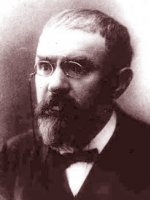
Doğum Tarihi - 29 Nisan 1854, Nancy, Lorraine, Fransa
Ölüm Tarihi - 17 Temmuz 1912, Paris, Fransa
Henri Poincaré's father was Léon Poincaré and his mother was Eugénie Launois.
They were 26 and 24 years of age, respectively, at the time of Henri's birth.
Henri was born in Nancy where his father was Professor of Medicine at the
University. Léon Poincaré's family produced other men of great distinction
during Henri's lifetime. Raymond Poincaré, who was prime minister of France
several times and president of the French Republic during World War I, was the
elder son of Léon Poincaré's brother Antoine Poincaré. The second of Antoine
Poincaré's sons, Lucien Poincaré, achieved high rank in university
administration.
In 1862 Henri entered the Lycée in Nancy (now renamed the Lycée Henri Poincaré
in his honour). He spent eleven years at the Lycée and during this time he
proved to be one of the top students in every topic he studied. Henri was
described by his mathematics teacher as a "monster of mathematics" and he won
first prizes in the concours général, a competition between the top pupils from
all the Lycées across France.
Poincaré entered the Ecole Polytechnique in 1873, graduating in 1875. He was
well ahead of all the other students in mathematics but, perhaps not
surprisingly given his poor coordination, performed no better than average in
physical exercise and in art. Music was another of his interests but, although
he enjoyed listening to it, his attempts to learn the piano while he was at the
Ecole Polytechnique were not successful. Poincaré read widely, beginning with
popular science writings and progressing to more advanced texts. His memory was
remarkable and he retained much from all the texts he read but not in the manner
of learning by rote, rather by linking the ideas he was assimilating
particularly in a visual way. His ability to visualise what he heard proved
particularly useful when he attended lectures since his eyesight was so poor
that he could not see the symbols properly that his lecturers were writing on
the blackboard.
After graduating from the Ecole Polytechnique, Poincaré continued his studies at
the Ecole des Mines. His [21]:-
... meticulous notes taken on field trips while a student there exhibit a deep
knowledge of the scientific and commercial methods of the mining industry; a
subject that interested him throughout his life.
After completing his studies at the Ecole des Mines Poincaré spent a short while
as a mining engineer at Vesoul while completing his doctoral work. As a student
of Charles Hermite, Poincaré received his doctorate in mathematics from the
University of Paris in 1879. His thesis was on differential equations and the
examiners were somewhat critical of the work. They praised the results near the
beginning of the work but then reported that the (see for example [21]):-
... remainder of the thesis is a little confused and shows that the author was
still unable to express his ideas in a clear and simple manner. Nevertheless,
considering the great difficulty of the subject and the talent demonstrated, the
faculty recommends that M Poincaré be granted the degree of Doctor with all
privileges.
Immediately after receiving his doctorate, Poincaré was appointed to teach
mathematical analysis at the University of Caen. Reports of his teaching at Caen
were not wholly complimentary, referring to his sometimes disorganised lecturing
style. He was to remain there for only two years before being appointed to a
chair in the Faculty of Science in Paris in 1881. In 1886 Poincaré was nominated
for the chair of mathematical physics and probability at the Sorbonne. The
intervention and the support of Hermite was to ensure that Poincaré was
appointed to the chair and he also was appointed to a chair at the Ecole
Polytechnique. In his lecture courses to students in Paris [2]:-
... changing his lectures every year, he would review optics, electricity, the
equilibrium of fluid masses, the mathematics of electricity, astronomy,
thermodynamics, light, and probability.
Poincaré held these chairs in Paris until his death at the early age of 58.
Before looking briefly at the many contributions that Poincaré made to
mathematics and to other sciences, we should say a little about his way of
thinking and working. He is considered as one of the great geniuses of all time
and there are two very significant sources which study his thought processes.
One is a lecture which Poincaré gave to l'Institute Général Psychologique in
Paris in 1908 entitled Mathematical invention in which he looked at his own
thought processes which led to his major mathematical discoveries. The other is
the book [30] by Toulouse who was the director of the Psychology Laboratory of
l'Ecole des Hautes Etudes in Paris. Although published in 1910 the book recounts
conversations with Poincaré and tests on him which Toulouse carried out in 1897.
In [30] Toulouse explains that Poincaré kept very precise working hours. He
undertook mathematical research for four hours a day, between 10 am and noon
then again from 5 pm to 7 pm. He would read articles in journals later in the
evening. An interesting aspect of Poincaré's work is that he tended to develop
his results from first principles. For many mathematicians there is a building
process with more and more being built on top of the previous work. This was not
the way that Poincaré worked and not only his research, but also his lectures
and books, were all developed carefully from basics. Perhaps most remarkable of
all is the description by Toulouse in [30] of how Poincaré went about writing a
paper. Poincaré:-
... does not make an overall plan when he writes a paper. He will normally start
without knowing where it will end. ... Starting is usually easy. Then the work
seems to lead him on without him making a wilful effort. At that stage it is
difficult to distract him. When he searches, he often writes a formula
automatically to awaken some association of ideas. If beginning is painful,
Poincaré does not persist but abandons the work.