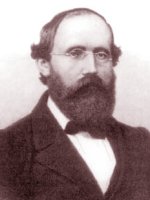
Doğum Tarihi - 17 Eylül 1826, Breselenz, Hanover
Ölüm Tarihi - 20 Haziran 1866, Selasca, İtalya
Bernhard Riemann's father, Friedrich Bernhard Riemann, was a Lutheran minister.
Friedrich Riemann married Charlotte Ebell when he was in his middle age.
Bernhard was the second of their six children, two boys and four girls.
Friedrich Riemann acted as teacher to his children and he taught Bernhard until
he was ten years old. At this time a teacher from a local school named Schulz
assisted in Bernhard's education.
In 1840 Bernhard entered directly into the third class at the Lyceum in Hannover.
While at the Lyceum he lived with his grandmother but, in 1842, his grandmother
died and Bernhard moved to the Johanneum Gymnasium in Lüneburg. Bernhard seems
to have been a good, but not outstanding, pupil who worked hard at the classical
subjects such as Hebrew and theology. He showed a particular interest in
mathematics and the director of the Gymnasium allowed Bernhard to study
mathematics texts from his own library. On one occasion he lent Bernhard
Legendre's book on the theory of numbers and Bernhard read the 900 page book in
six days.
In the spring of 1846 Riemann enrolled at the University of Göttingen. His
father had encouraged him to study theology and so he entered the theology
faculty. However he attended some mathematics lectures and asked his father if
he could transfer to the faculty of philosophy so that he could study
mathematics. Riemann was always very close to his family and he would never have
changed courses without his father's permission. This was granted, however, and
Riemann then took courses in mathematics from Moritz Stern and Gauss.
It may be thought that Riemann was in just the right place to study mathematics
at Göttingen, but at this time the University of Göttingen was a rather poor
place for mathematics. Gauss did lecture to Riemann but he was only giving
elementary courses and there is no evidence that at this time he recognised
Riemann's genius. Stern, however, certainly did realise that he had a remarkable
student and later described Riemann at this time saying that he:-
Riemann moved from Göttingen to Berlin University in the spring of 1847 to study
under Steiner, Jacobi, Dirichlet and Eisenstein. This was an important time for
Riemann. He learnt much from Eisenstein and discussed using complex variables in
elliptic function theory. The main person to influence Riemann at this time,
however, was Dirichlet. Klein writes in [4]:-
Riemann was bound to Dirichlet by the strong inner sympathy of a like mode of
thought. Dirichlet loved to make things clear to himself in an intuitive
substrate; along with this he would give acute, logical analyses of foundational
questions and would avoid long computations as much as possible. His manner
suited Riemann, who adopted it and worked according to Dirichlet's methods.
Riemann's work always was based on intuitive reasoning which fell a little below
the rigour required to make the conclusions watertight. However, the brilliant
ideas which his works contain are so much clearer because his work is not overly
filled with lengthy computations. It was during his time at the University of
Berlin that Riemann worked out his general theory of complex variables that
formed the basis of some of his most important work.
In 1849 he returned to Göttingen and his Ph.D. thesis, supervised by Gauss, was
submitted in 1851. However it was not only Gauss who strongly influenced Riemann
at this time. Weber had returned to a chair of physics at Göttingen from Leipzig
during the time that Riemann was in Berlin, and Riemann was his assistant for 18
months. Also Listing had been appointed as a professor of physics in Göttingen
in 1849. Through Weber and Listing, Riemann gained a strong background in
theoretical physics and, from Listing, important ideas in topology which were to
influence his ground breaking research.
Riemann's thesis studied the theory of complex variables and, in particular,
what we now call Riemann surfaces. It therefore introduced topological methods
into complex function theory. The work builds on Cauchy's foundations of the
theory of complex variables built up over many years and also on Puiseux's ideas
of branch points. However, Riemann's thesis is a strikingly original piece of
work which examined geometric properties of analytic functions, conformal
mappings and the connectivity of surfaces.
In proving some of the results in his thesis Riemann used a variational
principle which he was later to call the Dirichlet Principle since he had learnt
it from Dirichlet's lectures in Berlin. The Dirichlet Principle did not
originate with Dirichlet, however, as Gauss, Green and Thomson had all made use
if it. Riemann's thesis, one of the most remarkable pieces of original work to
appear in a doctoral thesis, was examined on 16 December 1851. In his report on
the thesis Gauss described Riemann as having:-
... a gloriously fertile originality.
On Gauss's recommendation Riemann was appointed to a post in Göttingen and he
worked for his Habilitation, the degree which would allow him to become a
lecturer. He spent thirty months working on his Habilitation dissertation which
was on the representability of functions by trigonometric series. He gave the
conditions of a function to have an integral, what we now call the condition of
Riemann integrability. In the second part of the dissertation he examined the
problem which he described in these words:-
While preceding papers have shown that if a function possesses such and such a
property, then it can be represented by a Fourier series, we pose the reverse
question: if a function can be represented by a trigonometric series, what can
one say about its behaviour.
To complete his Habilitation Riemann had to give a lecture. He prepared three
lectures, two on electricity and one on geometry. Gauss had to choose one of the
three for Riemann to deliver and, against Riemann's expectations, Gauss chose
the lecture on geometry. Riemann's lecture Über die Hypothesen welche der
Geometrie zu Grunde liegen (On the hypotheses that lie at the foundations of
geometry), delivered on 10 June 1854, became a classic of mathematics.
There were two parts to Riemann's lecture. In the first part he posed the
problem of how to define an n-dimensional space and ended up giving a definition
of what today we call a Riemannian space. Freudenthal writes in [1]:-
It possesses shortest lines, now called geodesics, which resemble ordinary
straight lines. In fact, at first approximation in a geodesic coordinate system
such a metric is flat Euclidean, in the same way that a curved surface up to
higher-order terms looks like its tangent plane. Beings living on the surface
may discover the curvature of their world and compute it at any point as a
consequence of observed deviations from Pythagoras' theorem.
In fact the main point of this part of Riemann's lecture was the definition of
the curvature tensor. The second part of Riemann's lecture posed deep questions
about the relationship of geometry to the world we live in. He asked what the
dimension of real space was and what geometry described real space. The lecture
was too far ahead of its time to be appreciated by most scientists of that time.
Monastyrsky writes in [6]:-
Among Riemann's audience, only Gauss was able to appreciate the depth of
Riemann's thoughts. ... The lecture exceeded all his expectations and greatly
surprised him. Returning to the faculty meeting, he spoke with the greatest
praise and rare enthusiasm to Wilhelm Weber about the depth of the thoughts that
Riemann had presented.
It was not fully understood until sixty years later. Freudenthal writes in [1]:-
The general theory of relativity splendidly justified his work. In the
mathematical apparatus developed from Riemann's address, Einstein found the
frame to fit his physical ideas, his cosmology, and cosmogony: and the spirit of
Riemann's address was just what physics needed: the metric structure determined
by data.
So this brilliant work entitled Riemann to begin to lecture. However [6]:-
Not long before, in September, he read a report "On the Laws of the Distribution
of Static Electricity" at a session of the Göttingen Society of Scientific
researchers and Physicians. In a letter to his father, Riemann recalled, among
other things, "the fact that I spoke at a scientific meeting was useful for my
lectures". In October he set to work on his lectures on partial differential
equations. Riemann's letters to his dearly-loved father were full of
recollections about the difficulties he encountered. Although only eight
students attended the lectures, Riemann was completely happy. Gradually he
overcame his natural shyness and established a rapport with his audience.
Gauss's chair at Göttingen was filled by Dirichlet in 1855. At this time there
was an attempt to get Riemann a personal chair but this failed. Two years later,
however, he was appointed as professor and in the same year, 1857, another of
his masterpieces was published. The paper Theory of abelian functions was the
result of work carried out over several years and contained in a lecture course
he gave to three people in 1855-56. One of the three was Dedekind who was able
to make the beauty of Riemann's lectures available by publishing the material
after Riemann's early death.
The abelian functions paper continued where his doctoral dissertation had left
off and developed further the idea of Riemann surfaces and their topological
properties. He examined multi-valued functions as single valued over a special
Riemann surface and solved general inversion problems which had been solved for
elliptic integrals by Abel and Jacobi. However Riemann was not the only
mathematician working on such ideas. Klein writes in [4]:-
... when Weierstrass submitted a first treatment of general abelian functions to
the Berlin Academy in 1857, Riemann's paper on the same theme appeared in
Crelle's Journal, Volume 54. It contained so many unexpected, new concepts that
Weierstrass withdrew his paper and in fact published no more.
The Dirichlet Principle which Riemann had used in his doctoral thesis was used
by him again for the results of this 1857 paper. Weierstrass, however, showed
that there was a problem with the Dirichlet Principle. Klein writes [4]:-
The majority of mathematicians turned away from Riemann ... Riemann had quite a
different opinion. He fully recognised the justice and correctness of
Weierstrass's critique, but he said, as Weierstrass once told me, that he
appealed to Dirichlet's Principle only as a convenient tool that was right at
hand, and that his existence theorems are still correct.
We return at the end of this article to indicate how the problem of the use of
Dirichlet's Principle in Riemann's work was sorted out.
In 1858 Betti, Casorati and Brioschi visited Göttingen and Riemann discussed
with them his ideas in topology. This gave Riemann particular pleasure and
perhaps Betti in particular profited from his contacts with Riemann. These
contacts were renewed when Riemann visited Betti in Italy in 1863. In [16] two
letter from Betti, showing the topological ideas that he learnt from Riemann,
are reproduced.
In 1859 Dirichlet died and Riemann was appointed to the chair of mathematics at
Göttingen on 30 July. A few days later he was elected to the Berlin Academy of
Sciences. He had been proposed by three of the Berlin mathematicians, Kummer,
Borchardt and Weierstrass. Their proposal read [6]:-
Prior to the appearance of his most recent work [Theory of abelian functions],
Riemann was almost unknown to mathematicians. This circumstance excuses somewhat
the necessity of a more detailed examination of his works as a basis of our
presentation. We considered it our duty to turn the attention of the Academy to
our colleague whom we recommend not as a young talent which gives great hope,
but rather as a fully mature and independent investigator in our area of science,
whose progress he in significant measure has promoted.
A newly elected member of the Berlin Academy of Sciences had to report on their
most recent research and Riemann sent a report on On the number of primes less
than a given magnitude another of his great masterpieces which were to change
the direction of mathematical research in a most significant way. In it Riemann
examined the zeta function
(s) = (1/ns) = (1 - p-s)-1
which had already been considered by Euler. Here the sum is over all natural
numbers n while the product is over all prime numbers. Riemann considered a very
different question to the one Euler had considered, for he looked at the zeta
function as a complex function rather than a real one. Except for a few trivial
exceptions, the roots of (s) all lie between 0 and 1. In the paper he stated
that the zeta function had infinitely many nontrivial roots and that it seemed
probable that they all have real part 1/2. This is the famous Riemann hypothesis
which remains today one of the most important of the unsolved problems of
mathematics.
Riemann studied the convergence of the series representation of the zeta
function and found a functional equation for the zeta function. The main purpose
of the paper was to give estimates for the number of primes less than a given
number. Many of the results which Riemann obtained were later proved by Hadamard
and de la Vallée Poussin.
In June 1862 Riemann married Elise Koch who was a friend of his sister. They had
one daughter. In the autumn of the year of his marriage Riemann caught a heavy
cold which turned to tuberculosis. He had never had good health all his life and
in fact his serious heath problems probably go back much further than this cold
he caught. In fact his mother had died when Riemann was 20 while his brother and
three sisters all died young. Riemann tried to fight the illness by going to the
warmer climate of Italy.
The winter of 1862-63 was spent in Sicily and he then travelled through Italy,
spending time with Betti and other Italian mathematicians who had visited
Göttingen. He returned to Göttingen in June 1863 but his health soon
deteriorated and once again he returned to Italy. Having spent from August 1864
to October 1865 in northern Italy, Riemann returned to Göttingen for the winter
of 1865-66, then returned to Selasca on the shores of Lake Maggiore on 16 June
1866. Dedekind writes in [3]:-
His strength declined rapidly, and he himself felt that his end was near. But
still, the day before his death, resting under a fig tree, his soul filled with
joy at the glorious landscape, he worked on his final work which unfortunately,
was left unfinished.
Finally let us return to Weierstrass's criticism of Riemann's use of the
Dirichlet's Principle. Weierstrass had shown that a minimising function was not
guaranteed by the Dirichlet Principle. This had the effect of making people
doubt Riemann's methods. Freudenthal writes in [1]:-
All used Riemann's material but his method was entirely neglected. ... During
the rest of the century Riemann's results exerted a tremendous influence: his
way of thinking but little.
Weierstrass firmly believed Riemann's results, despite his own discovery of the
problem with the Dirichlet Principle. He asked his student Hermann Schwarz to
try to find other proofs of Riemann's existence theorems which did not use the
Dirichlet Principle. He managed to do this during 1869-70. Klein, however, was
fascinated by Riemann's geometric approach and he wrote a book in 1892 giving
his version of Riemann's work yet written very much in the spirit of Riemann.
Freudenthal writes in [1]:-
It is a beautiful book, and it would be interesting to know how it was received.
Probably many took offence at its lack of rigour: Klein was too much in
Riemann's image to be convincing to people who would not believe the latter.
In 1901 Hilbert mended Riemann's approach by giving the correct form of
Dirichlet's Principle needed to make Riemann's proofs rigorous. The search for a
rigorous proof had not been a waste of time, however, since many important
algebraic ideas were discovered by Clebsch, Gordan, Brill and Max Noether while
they tried to prove Riemann's results. Monastyrsky writes in [6]:-