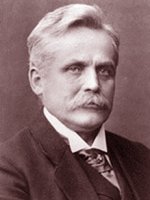
Doğum Tarihi - 13 Ocak 1864, Gaffken, Polanya
Ölüm Tarihi - 30 Ağustos 1928, Munich, Almanya
Wilhelm Wien worked at the Physikalisch- Technische Reichsanstalt in Berlin-
Charlottenburg where he was a colleague of Planck. Wien was appointed professor
of physics at Giessen in 1899 and professor of physics at Munich in 1920.
In 1893 Wien stated his displacement law of blackbody radiation spectra at
different temperatures. His method is described in [2]:-
It was [Wien's] idea to use as a good approximation for the ideal blackbody an
oven with a small hole. Any radiation that enters the small hole is scattered
and reflected from the inner walls of the oven so often that nearly all incoming
radiation is absorbed and the chance of some of it finding its way out of the
hole again can be made exceedingly small. The radiation coming out of this hole
is then very close to the equilibrium blackbody electromagnetic radiation
corresponding to the oven temperature.
In 1896 Wien derived a distribution law of radiation. Planck, who was a
colleague of Wien's when he was carrying out this work, later, in 1900, based
quantum theory on the fact that Wien's law, while valid at high frequencies,
broke down completely at low frequencies.
While studying streams of ionized gas Wien, in 1898, identified a positive
particle equal in mass to the hydrogen atom. Wien, with this work, laid the
foundation of mass spectroscopy. J J Thomson refined Wien's apparatus and
conducted further experiments in 1913 then, after work by E Rutherford in 1919,
Wien's particle was accepted and named the proton.
Wien received the 1911 Nobel Prize for his work on heat radiation.
In [4] a letter from Einstein to Wien is described in which he asks Wien to
conduct an experimental proof of the principle of equivalence which Einstein had
proposed from purely theoretical considerations in 1907:-
In 1912 [Einstein] turned by letter to W Wien with the request to measure the
difference between the periods of oscillation of pendulums made of uranium and
lead, as well as the proportionality of inertial and gravitational masses of a
uranium and a lead weight, respectively, namely with a torsion balance. The
letter testifies that Einstein was not aware of the Eötvös experiment when he
formulated the principle of equivalence ...
Wien also made important contributions to the study of cathode rays, X-rays and
canal rays.