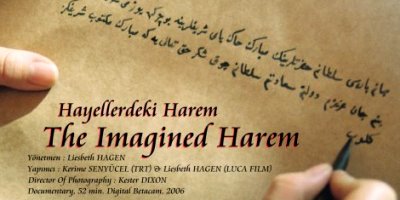
Yapım Tarihi - 2006
Süre - 00:52:00
Format - Belgesel, Renkli, İngilizce, Digital Betacam
Yönetmen - Liesbeth Hagen
Yapım - Trt & Luca Film
Yapımcı - Liesbeth Hagen (Luca Film), Kerime Senyücel (Trt)
Görüntü Yönetmeni - Kester Dıxon
Kameraman - Kester Dıxon, Hayri Çölaşan
Ses - Bert Van Den Dungen
Kamera Asistanı - Murat Yıldız
Set - Zuhal Özçelik
Prodüksiyon - Hülya Gürcan
Sanat Yönetmeni - Serdar Başbuğ
Aksesuar - Hülya Karakaş
Yapım Yardımcısı - Sinem Dirlik, Elif Kabacaoğlu
Ulaşım - Yaşar Küçükgüçlü, Fikret Bilgin, Osman Akçelik
Hayallerdeki Harem
“Düşlerdeki Harem” Belgeseli 2007de, (EBU) Avrupa Yayın Birliği şemsiyesi
altında TRT ve Hollanda Avro Televizyonu ortak yapımı olarak gerçekleşti.
Batı dünyasında roman, şiir, konulu film, belgesel film tarzlarında defalarca,
ancak pek çok ön yargıyla yüklü oryantalist bir yaklaşımla ele alınan “Harem”
konusuna bu sefer, Hollandalı yönetmen Liesbeth Hagen, değişik bir açıdan
yaklaştı. TRT'nin işbirliğiyle, hayallerden yola çıkarak, gerçeklere doğru bir
yolculuk yapıldı. Batıda başlayan yolculuk, tarihçilerin araştırmalarında,
Osmanlı Arşivlerinde, Topkapı ve Dolmabahçe saraylarında son bulacaktı.
Belgeselin Türkiye danışmanları Prof. Zeynep İnankur, Prof. Edhem Eldem;
Hollanda danışmanı Sanat tarihçi Dr. Jan de Hond; müzik danışmanı Ruhi
Ayangil'dir.
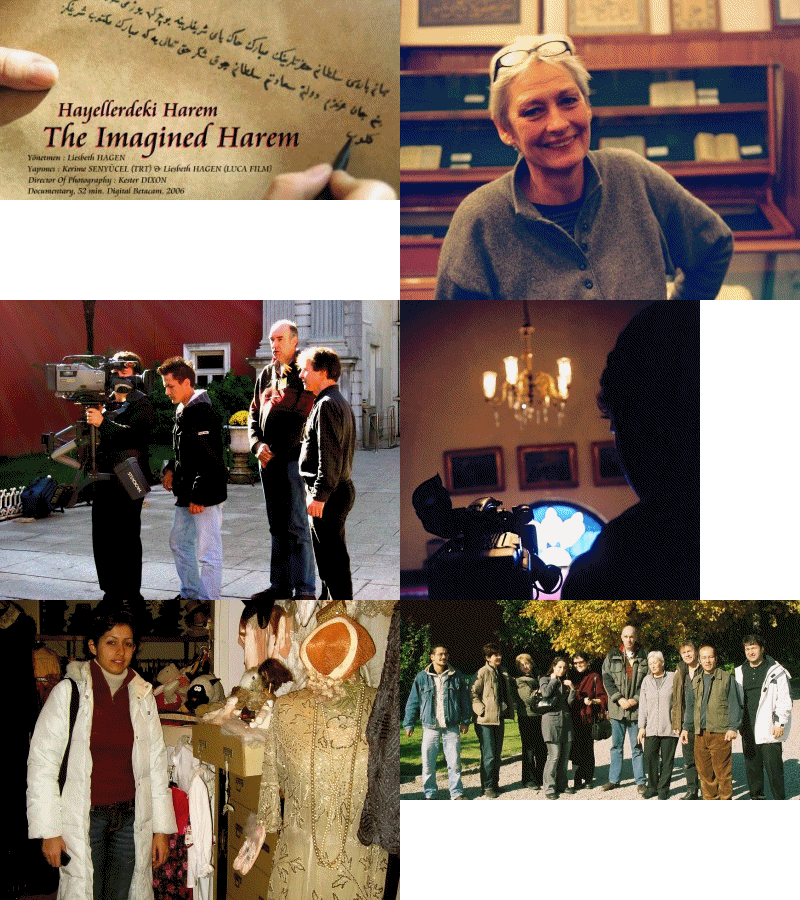
Belgeselin çekimleri Topkapı ve Dolmabahçe’de ,Yıldız Saraylarında
yapıldı.Çekimlerin bir kısmı da Hollanda ve İngiltere'de yapıldı.
Yapımcı Kerime Senyücel,yönetmen ve senaryo yazarı Liesbeth Hagen, kameraman
Kester Dixon, sesçi Bert van der Dungen, yardımcı kameraman Hayri Çölaşan’ın
katıldığı bir ekiple çekimler yapıldı. Filmin müzikleri Prof Ruhi Ayangil’e ait.
Klasik Türk Musikisinden de Özgün örnekler kullanıldı. Avrupa'da da birçok kez
yayınlanan belgesel TRT ekranlarında yeniden izleyiciyle buluşuyor.
TRT-2
13/02/2010 Cumartesi
Saat:22:00
The Imagined Harem
Documentary, 52 min. Digital Betacam, 2006
Crew
Director - Liesbeth Hagen
Product - Trt & Luca Film & Lagestee Film
Producer - Lagestee Fılm - Liesbeth Hagen (Luca Film), Kerime Senyucel (Trt)
Director Of Photography - Kester Dıxon
Cameraman - Kester Dıxon, Hayri Colasan
Sound - Bert Van Den Dungen
Camera Assistant - Murat Yıldız
Set - Zuhal Ozcelık
Production - Hulya Gurcan
Art Director - Serdar Basbug
Accessory - Hulya Karakas
Producer Asistant - Sinem Dırlık, Elif Kabacaoglu
Driver - Yaşar Kuçukguclu, Fikret Bılgın, Osman Akcelık
Subject
Length- 52 minutes
Programme formula- cultural
The Imagined Harem - where Western fantasy meets Oriental fact
The imaginative depiction of the harem in Western art is worlds away from the reality of the true-life harems of the
East. It was this contrast between the romanticised image and the historical truth that I found fascinating and which
made me decide on the subject of the film.
As the main source of inspiration of Western artists was drawn from the harems of the sultans, my focus gravitated quite
naturally to these renowned Turkish harems.
Perspective
Using the knowledge we have of harems today as a contrasting benchmark, I shall flesh out the vision of the harem as it
appeared through the eyes of Western artists with examples drawn mainly from painters and writers, I intend to show how
this vision has continued to persist right through to the present day.
Because of the vivid contrast between facts and fantasy, the film is underpinned by the dynamic interaction between the
reality of actual harems and western dreams about them.
TREATMENT
What image do we have of harems in the West?
European harem fantasies have their taproots sunk in a variety of art forms. In the field of painting, for example, the
works of Ingres, Matisse, Delacroix or Picasso supply a wealth of fanciful inspiration, just as do those classic
Hollywood films portraying harem wives as scantily clothed belly dancers eager to please their ravishers. Then we have
operas, which include Verdi's Aïda, Mozart's Die Entführung aus dem Serail and ballets, such as Diaghiliev's Sheherazade.
Whatever the form, harems are serially depicted as fantasy wonderlands, dripping with sex and sensuality and brimful
with vulnerable, naked women.
From the 18th century onwards, similarly imaginative visions were drawn from European translations of A Thousand and One
Nights, which at the time was considered a reliable representation of the Islamic world. I shall underline this key role
played by the imagination in Western art, using comments by people from the West about their ideas, perceptions and
fantasies of what harems were really like.
This will be contrasted with the historical truth.
The historical reality of the harem
The sultan's harem was hermetically sealed off from the outside world. In its heyday, during the 17th and 18th centuries,
the harem precincts were strictly guarded by an army of 600-800 eunuchs. Veiled in an aura of secrecy, people still do
not fully know exactly what went on there. They were haram, which means forbidden, protected, holy. The women's quarters
were thus called HAREM.
Except for the sultan and the princes, no man was allowed to enter the women's quarters. The eunuchs guarded not only
all entrances and exits, but also all passageways, courtyards and storerooms. At times, the bodyguard of the sultan’s
mother alone consisted of thirty men.
In other words, Turkish harems of that period were most certainly not palaces draped with half naked women, hanging
around in marble halls, waiting on their master‘s whim. They weren't naked at all, but on the contrary were usually
concealed under multiple layers of clothes. The harem was a world in itself, governed not by a man but by a woman. And
this woman, the contemporary equivalent of a prime minister, was not the sultan's first wife as is commonly supposed,
but the sultan's very own mother. It was to her that her son’s most personal possessions, his wives, were entrusted. She
too, was the one who in turn selected the women for her son.
The film will explain the origins of the harem system, describe the strict hierarchy in the sultans harem and describe
its eventual decline and fall.
How did we come upon this information about harems in the West?
As it was virtually impossible for writers or painters to enter a harem, fact and fiction are often extensively
intertwined in their reports and depictions. I will show how art and literature helped create a distorted image of the
harem in Western culture over the centuries.
Amongst others I intend to use excerpts from travel diaries/stories. I will also use a number of accounts written by
European women, as it was slightly easier for women to gain admittance to a harem. They were able to visit the harem
inmates and report on their true adventures, as did Lady Montagu, an ambassador’s wife, in the 18th century.
In the 19th century, the popularity of Oriental art caused a true craze in the West for all things Turkish. The upper
class had their portraits done dressed in Turkish robes. And while European painters were still trying to capture the
colour of oriental exoticism, sketching away in small alleyways, in markets, in Turkish baths and busy painting
odalisques on cushions, western influence had meanwhile penetrated all the way to the soft centre of the harem.
Even the typical, soft-cushioned Oriental way of life was being replaced by imported chairs and sofas. While in the
West, the posh were lounging on cushions, the posh in the East were, awkwardly, starting to sit up straight.
Format
The closed nature of the harem will serve as backcloth for the way Western art grafted itself onto the East. My
intention is to illustrate as many facts as possible through images alone; such as recurring shots of high walls, closed
gates and barred windows, in themselves revelatory of the hermetic nature of the harem. I will try to let these shots
‘speak for themselves’ as much as possible. This approach will highlight to best advantage the contrast between the
rigid reality of historical truth and the dramatised images we have of harems.
I will back up the ‘suggestive’ images with writings by Eastern women. The archives of the Topkapi palace contain
correspondence from the harem; for instance the letters that Roxelana, Sultan Süleyman the Magnificent’s first wife,
wrote to her husband. These letters reveal the power and authority that a woman in her position held at the time.
In order to prevent the images in Istanbul from being too static, I will include some scenes with minimal acting. For
example- At the same time as Western painters are indulging in orgies of colourful Eastern cushions scattered with
lounging harem women, European chairs and tables are shown being carried into the Dolmabaçhe palace. The first
appearance of harem trousers in the West is mirrored by Turks starting wearing tight western trousers.
The introduction of Western objects into this otherwise so impenetrable world serves as a symbol for the pervasive
influence of the West.
By repeatedly mixing these kinds of images and movements, the cultural cross-fertilisation will become clear on screen.
The showing of key Western “harem” paintings will be accompanied by readings from those literary sources (insofar as
these Can be traced) that inspired the artists.
I will also use expressions in modern art, in which we Can see that the point of view of the artist hasn’t changed over
the years.
Also young modern Turkish artists represent the ladies of the harem naked. That is the reason why I will ask Turkish and
Dutch academy students to design a peep show (i.e. a box with a little hole, through which you Can see a harem scene)
because of its voyeuristic character.
Throughout the film we will see fragments of the progress of the work of two students, one Turkish and one Dutch student.
At the end of the film we show a compilation of the finished work of all students.
The people who will be interviewed
The film will feature interviews with Professor Zeynep Inankur, Professor Nurhan Atasoy, Professor Necdet Sakaoğlu from
Turkey, and Nahed Selim from Holland:
Professor Zeynep Inankur has worked at the Art History Department (Western and Contemporary Art) of Mimar Sinan
University since the 1970’s. She has undertaken research on the harems of the sultans and is expert on Oriental art. She
will be our guide in our search for the facts and roots of the harem fantasies.
She is amongst others author of Constantinople and the Orientalists, and has carried out research on the sultans' harems
and is expert in the field of oriental art.
She will, where necessary, put Western art in its historical context.
Professor Necdet Sakaoğlu is a historian and author of numerous books about the harem. He will talk about the
architecture of the palace. Based on the location of the rooms of the sultan, his mother and the sultan’s wives, he will
analyze how the internal relationship between them must have been.
Professor Nurhan Atasoy was during her academic life B.A., M.A., Ph.D. at the department of Fine Arts and Art History,
She retired in 1999 and works at the moment to complete the unfinished projects and on new projects; she lectured at
many international congresses and symposiums, participated in research and international meetings on Turkish and Islamic
art throughout the World.
In our film she will talk about the life of the women in the harem. In particular the separation of women slaves and the
way they dress.
Nahed Selim is interpreter and author. She is from Egypt, but lives in Holland. She published amongst others the book
‘The women of the prophet’ about the origin of the separation of women and the origin about the use of veils. She will
tell us about her conclusions.
Music
Ruhi Ayangil will be our guide for the Turkish court music. Besides the music of Ensemle Ayangil
I will give examples of women composers from the past and the present day.
The music group The women's ensemble of Istanbul play in authentic costumes 'music of the harem'.
Advice
Dr. Kiymet Giray is the author of various books. Besides, her investigations, articles and critiques about the art
history, especially on Turkish Plastic Art and Turkish Painters, Dr. Giray works especially on the Harem in Art and
gives workshops about this subject.
I intend to ask Dr. Giray to supervice the making of the harem ‘peep shows’ of the academy students.
Emre Araci read music at the University of Edinburgh and graduated in 1994. He became Research Associate at the
Skilliter Centre for Ottoman Studies, Newnham College, University of Cambridge, where he did research on European music
at the Ottoman court. Nowadays he is a composer and conductor and has been based in the United Kingdom since 1987. He
founded the Edinburgh University String Orchestra in1992 and is director of the London Academy of Ottoman Court Music.
Emre Araci will be our adviser for the Western music influenced by Eastern sources.
Professor Machiel Kiel is a historian and art historian of the Islamic world. Kiel has, among other things, more than
160 publications to his name on the cultural history of the Ottoman Empire, is an expert in the field of eastern
miniatures, has contributed to French, English and Turkish encyclopaedias and is adviser in Islamic art in Bosnia for
Unesco. He will be our adviser for the Turkish miniatures.
Current status of research
As far as the art material is concerned, we know what is extant and where it Can be found, but we still need to make a
selection. The same goes for literary quotations and excerpts and examples from other art forms.
To date, no information has been obtained regarding the rights of the above.
Production Team
Director- Liesbeth Hagen
Production Houses - Lagestee Productions, LUCA Film
Broadcaster AVRO, represented by Marijke Huijbregts
Camera - Andras Hamelberg
Sound - Menno Euwe
Adres
Liesbeth Hagen
Luca Film
Bogortuin 149
1019 PE Amsterdam
The Netherlands
T +31 204194491
T Privat +31 204194555
F +31 204194493