Yapım Tarihi - 2026
Süre - 00:03:38
Format - Kurmaca, Renkli, Türkçe
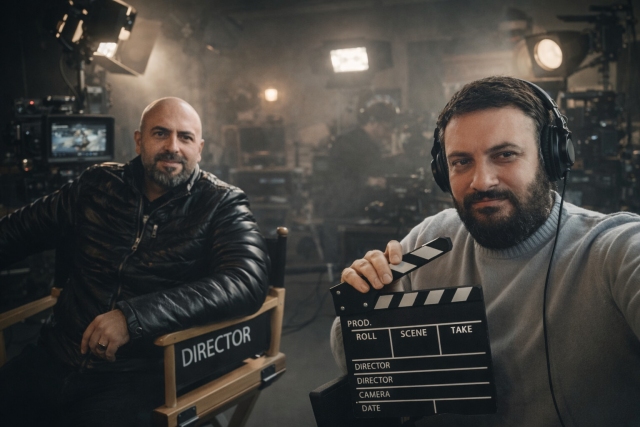
Yönetmen / Director - Bahadır Hekim
Senarist / Writer - Bahadır Hekim
Yapımcı / Producer - Bahadır Hekim
Ana Karakter / Key Cast
Çağın Avşar
A man living in isolation is forced to confront his own mind as silence turns
into a presence he can no longer escape. Moving between a deserted shoreline, a
forest, and an abandoned house, the boundary between reality and hallucination
begins to collapse. A mysterious woman who appears behind him gradually reveals
herself as a manifestation of his suppressed identity. As he runs from this “other,”
he is drawn toward an inevitable and irreversible end. The film portrays madness
not as an eruption, but as a quiet and inescapable descent. A man living in
isolation is forced to confront his own mind as silence turns into a presence he
can no longer escape. Moving between a deserted shoreline, a forest, and an
abandoned house, the boundary between reality and hallucination begins to
collapse. A mysterious woman who appears behind him gradually reveals herself as
a manifestation of his suppressed identity. As he runs from this “other,” he is
drawn toward an inevitable and irreversible end. The film portrays madness not
as an eruption, but as a quiet and inescapable descent. With this film, I wanted
to explore the idea that madness is not always loud or violent. Sometimes it
arrives quietly, through isolation, repetition, and silence.
RABIDUS was born from the question of what happens when a person is left alone
with their own mind for too long.
Rather than presenting an external threat, the film focuses on an internal one.
The female figure is not meant to be perceived as a character, but as a
reflection — a manifestation of the protagonist’s divided self. Nature and empty
spaces become extensions of the character’s psychology, mirroring his gradual
loss of boundaries between reality and perception.
I was interested in creating tension without relying on conventional horror
techniques. Minimal dialogue, restrained movement, and sound design were
essential tools in telling this story. The ending embraces inevitability rather
than shock, portraying death not as an act of violence, but as a final form of
acceptance.
This film is an attempt to confront the fear of becoming one’s own “other.”